
Ultrasonic Cleaning of Optical Devices
Q. Ultrasonic and forced DI water are not removing particles from the optical devices. We suspect that the particles are charged and that is playing a role in the difficulty of removing them. Rusting isn’t a problem but oxidation might be. Al, Ti are metals in the devices we use. The cleaning is followed by chemical etching so this can be an issue.
Click to read the answer.
Improving DI Water Wettability
Q. We are looking for a low concentration surfactant to improve DI water wetting to polycarbonate and stainless steel during an aerated flushing operation for removal of sub-micron surface particles. Our parts are cleaned before assembly – we need to improve a DI-water flushing operation that is meant to remove sub-micron sized surface particulate from inside an assembled gas path (tube). How can we improve wettability of DI water?
Comparing powder and liquid detergents
Q. We frequently use 55-gal drums of Liquinox to remediate gasoline contaminated soil and groundwater. We are not cleaning lab glassware. We inject it into the groundwater at hazardous waste sites to solubilize the globules of gasoline or other contaminants trapped in the porous spaces of the soil. I would like to know if it is cheaper to buy the powdered Alconox and dissolve it? Is there an equivalent unit of measure to evaluate the two?
Read the answer.
Determining Optimum Detergency for Liquinox
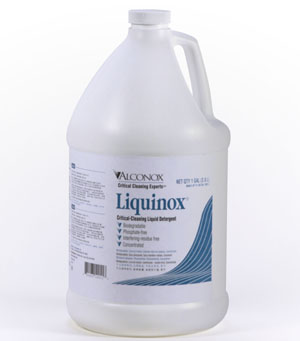
How do you determine optimum detergency for Liquinox detergent? As a general statement, optimum detergency is reached at a 1-2% concentration (optimum defined as amount of soil removed per unit of detergent used). Maximum detergency is typically reached at a…
Determining Aquatic Toxicity
Alconox® Powdered Precision Cleaner, Liquinox® Critical Cleaning Liquid Detergent, Tergazyme® Enzyme-Active Powdered Detergent, Citranox® Liquid Acid Cleaner and Detergent, and Alcotabs® Tablet Pipet Detergent all contain roughly 5-20% sodium dodecylbenzene sulfonate surfactant. The aquatic toxicity is derived from the surfactant. This surfactant is sodium dodecylbenzene sulfonate.
