Removing Trace Contaminants of Phenol
Q. We are attempting to validate our glassware washing process and found trace contaminants of phenol remaining after the washing process. Is there another detergent that is able to remove phenol better then Liquinox®?
A. In general, for manual cleaning, Liquinox® should be an excellent choice for removal of phenol residues. For very low level trace analysis, additional rinsing may be required. For routine laboratory cleaning, a triple rinse is typically used. For trace analysis, a 6 time rinse with purified water is typically used. For extreme low level trace analysis . . .
HPLC Method
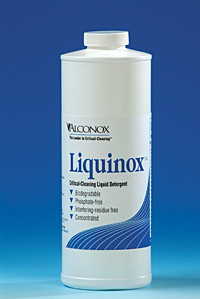
Q. Do you have HPLC methods for Liquinox®?
A. Yes. Contact Alconox, LLC technical service to receive copies of the HPLC methods for Liquinox®. Alconox.com has many resources for Liquinox® and other detergents. These resources include:
Oxygenated products in Liquinox?
Q. Are there other oxygenated products/compounds in the Liquinox detergent?
A. Liquinox® does not contain any oxygen bleaches – peroxides. Liquinox® does contain ethoxylated alcohol nonionic surfactants which contain oxygen.
Leak Detection Detergent
Q. We need a liquid soap to be used for leak detection and also as a lubricant. Do you sell anything that will work?
A. Liquinox® detergent has good foaming characteristics for leak detection and also has lubricity as a lubricant.

Removing Trace Metals, Inorganics & Organics without Acid?
Q. We are trying to reanalyze our cleaning procedure. Do you have a product that removes trace metals, inorganics and organics without an additional acid rinse? We sample waste water influent and effluent and collect in plastic containers. Please let me know what you would recommend.
A. Organic residues are typically effectively removed by alkaline cleaning. The most robust way to remove trace metals and inorganics is to use an acid rinse. However . . .
