Air Shipping Citranox
Q. I want to air ship a sample of Citranox to one of our vendors for evaluation. Are there any shipping limitations on Citranox?
A. Citranox is a non-hazardous detergent that has no shipping restrictions or limitations.

Cleaning Aluminum with Alconox
Q. Which Alconox cleaners can be used on Aluminum?
A. The Alconox brand cleaners recommended for cleaning aluminum are Alconox, Liquinox, Tergazyme, Alcojet, Alcotabs, Detojet, Citranox, Luminox, Citrajet, Solujet and Tergajet. Detergent 8 is not recommended for cleaning aluminum. Aluminum forms a natural passive layer in air that allows it to be successfully cleaned without adverse reactions with cleaner. A passive layer forms in under an hour, provided there is no oily film present. Once the passive layer is formed, the recommended Alconox brand cleaners can be used to clean the aluminum at concentrations of less than 5% at 90 deg C or less for up to one hour.
Cleaners for Medical Device Classes
Q. What classes of medical devices are Alconox brand cleaners formulated to clean?
A. Alconox brand cleaners are formulated to clean Class I, II, and III medical devices. For further information please visit the Medical Device Cleaning section of the Alconox website.
According to www.fda.gov , the FDA classifies medical devices into three categories . . .
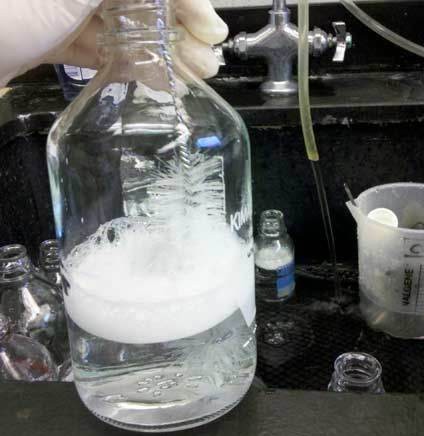
Is Alconox detergent the same as Liquinox detergent?
Q. Is the Alconox powder equivalent to the Liquinox liquid? If these are the same could you please provide me with some sort of documentation saying that Alconox is the powdered form of Liquinox and that they are interchangeable?
Maximum Wash Temperature for Liquinox
Q. What is the maximum wash temperature for Liquinox? At this maximum temperature is there an accelerated breakdown of detergent?
A. Liquinox is heat stable all the way to boiling at standard temperature and pressure conditions. From a practical standpoint, there are some detergency mechanisms that begin to break down mechanistically as you approach boiling. Emulsions begin to become less stable as you approach within a couple degrees of boiling. If emulsifying is not a critical cleaning mechanism, this may not be relevant to you.
