Density of Alconox Detergent
Q. Do you have the density of the Alconox detergent?
A. Thanks for your request for Alconox density. Alconox is a hygroscopic dry blended powder with a density that varies with settling and humidity. The density of Alconox varies from 0.85 g/mL to 1.1 g/mL, with a typical density of 0.95 g/mL.
Learn More.
Custom Detergent Formulations
Q. Does Alconox, Inc. make custom detergent formulations to solve special cleaning problems?
A. Yes, Alconox, Inc. will make custom formulations to solve special cleaning problems. Of course we always try to solve cleaning problems with off the shelf cleaners, but if there are special cleaning needs that cannot be met using regular Alconox brand cleaners, then where the size of business warrants manufacturing a new formulation, we will make custom detergents.
Click for more details.
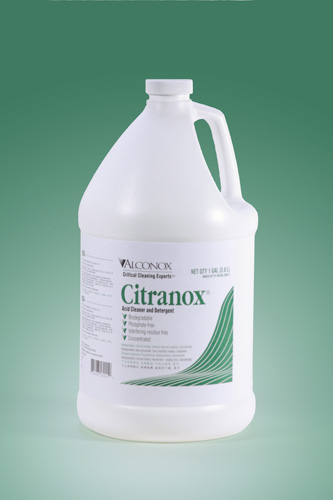
Comparing Citranox to Citric Acid
Q. Is Citranox comparable to citric acid?
A. Yes, 1% Citranox® Liquid Acid Cleaner and Detergent can be used to replace the kind of cleaning achievable from 1% citric acid. The Citranox cleaner formulation is approximately 1/3 citric and other organic acids by weight…. Learn more
Cleaning Machine Oil with Liquinox
Q. We are cleaning straight machine oil off parts, followed by a Ozonics 203 dip. We have a vapor degreaser but stopped using it due to odors & EPA exhaust concerns. I plan to use Liquinox in a strong concentration to remove the residual oil and Ozonics 203. I plan to use the degreaser as a heated ultrasonic cleaner. What concentration would you recommend? This would be followed by our final u.s. cleaning using 2% Liquinox & dual cascading D.I. water.
Click for the answer.

Environmental Issues in Aqueous Cleaning
Q. What are environmental issues are involved with aqueous cleaning?
A. Generally, the environmental impact and issues involved in aqueous cleaning have to do with the ingredients used and their ultimate discharge into the environment. Taking a larger view, it is also important to consider the energy and resources consumed in making and using the cleaner. There are several important factors concerning discharge of spent cleaning solutions into the environment: biodegradability, aquatic toxicity and eutrophication acceleration. Learn More.
