Published: August 26, 2026
This TechNote was developed in collaboration with Critical Process Filtration, Inc., a fellow TCP Analytical company and manufacturer of membrane and depth media filtration products for pharmaceutical, biotech, and food and beverage processing.
One good way to minimize filtration costs is to employ filters capable of being cleaned (and sanitized if required) for reuse. Preparing filters for reuse should have two objectives. The first is to clean the filter by removing particulates and other contaminants that are causing reduced flow through the filter. The second is to sanitize the filters to kill any unwanted microorganisms.
In developing the process required to properly prepare filters for reuse, it is important to remember that sanitization and sterilization are not the same as cleaning.
Cleaning the filters is a vital first step. Otherwise, the high temperatures and/or harsh chemicals used for sanitizing the filter may cause the surface contamination to permanently bond to the filter, resulting in a permanent loss of flow capacity.
Identifying an effective filter cleaning procedure depends on several factors, such as particulate vs biological contamination and contaminant affinity to the filter material (binding).
For heavy particulate loading, often times a simple back flush is sufficient to clean the filter surface. This requires incorporating the back flush capability into the original system, or having an off-line cleaning set up to do so.
Depending on the nature of the contaminant, simple flushing or even back flushing may not be sufficient for effective cleaning. In these cases, using a cleaning agent, such as Tergazyme® Enzyme-Active Powdered Detergent from Alconox, LLC can be a good choice to help break up the contamination and return your filters to good working order.
Filter cleaning using these agents is typically performed off line to prevent the cleaning agent spreading into the process. After removing the filter, the first step is a water rinse to remove loose and soluble particles. Depending on the cleaning process requirements this may also include a back flush.
After flushing, the filter is then cleaned with Tergazyme detergent following the manufacturer’s instructions for use. The filter must be thoroughly rinsed after cleaning to remove all residual cleaning agent. The filter is then ready for any required sanitization steps. This can also be done off line (such as preparing the filter to be stored for later reuse), or in line after reinstalling the filter.
Critical Process Filtration has published detailed filter cleaning and sanitization instructions, including the use of detergents such as Tergazyme.
For more information on cleaning and sanitizing filters for reuse, contact CustomerService@criticalprocess.com.
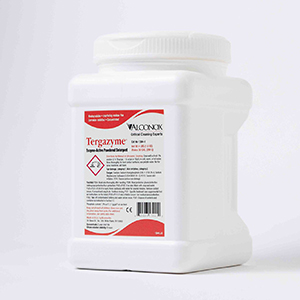
Tergazyme is a concentrated, anionic detergent with protease enzyme for manual and ultrasonic cleaning. Excellent for removal of proteinaceous soils, tissue, blood and body fluids from glassware, metals, plastic, ceramic, porcelain, rubber and fiberglass with no interfering residues. Ideal as a cleaning agent in Reverse Osmosis and Ultra-Filtration Systems. USDA authorized. Dilute: 1:100. pH 9.5
Do you have a critical cleaning question for the experts at Alconox, LLC? Search TechNotes to see if it’s been answered before or Ask Alconox.
To request any Alconox, LLC detergents for free, please complete the questionnaire at Get Sample. For more information about any one of our Alconox, LLC detergents, consult the technical bulletin for each product. Or click here to access each of our detergent’s Safety Data Sheets
Have a clarifying question? Submit it here. cleaning@alconox.com